Starting a strength training program for the first time can feel overwhelming. There's an enormous amount of information out there — much of it contradictory — and it's easy to get paralyzed before you ever pick up a weight. This guide is designed to cut through the noise and give you a clear, straightforward starting point for home-based strength training.
The good news: you don't need a lot of equipment, a lot of space, or a lot of time to build real strength at home. What you need is the right framework and the consistency to apply it.
What Is Strength Training?
Strength training — also called resistance training or weight training — is any form of exercise that requires your muscles to work against an external load. That load can be a dumbbell, a barbell, a kettlebell, a resistance band, or even your own bodyweight. When your muscles work against resistance, they develop micro-tears that your body repairs and rebuilds, making the muscle fibers slightly thicker and stronger over time. That process is called muscle hypertrophy, and it's the foundation of all strength training.
Beyond aesthetics, strength training has well-documented health benefits: improved bone density, better posture, increased metabolism, improved joint health, reduced injury risk, and significant benefits for mental health and longevity.
The Foundational Movement Patterns
All strength training — regardless of what equipment you use — is built around six fundamental movement patterns. Learning to do these well will give you a complete and balanced training foundation:
- Squat — quad, glute, and core dominant. Examples: goblet squat, bodyweight squat, front squat.
- Hip Hinge — hamstring, glute, and lower back. Examples: Romanian deadlift, kettlebell swing, good morning.
- Push (Horizontal) — chest, shoulders, triceps. Examples: push-up, dumbbell bench press, dumbbell floor press.
- Push (Vertical) — shoulders, triceps. Examples: overhead press, pike push-up.
- Pull (Horizontal) — back, biceps. Examples: dumbbell row, inverted row.
- Pull (Vertical) — lats, biceps. Examples: pull-up, lat pulldown.
A well-designed beginner program touches all six of these patterns every week. It doesn't need to be complicated — in fact, simpler is almost always better when starting out.
A Simple Beginner Program (3 Days/Week)
Here's a straightforward 3-day full-body program that works with a basic dumbbell or kettlebell setup:
Day A
- Goblet Squat — 3 sets × 10 reps
- Dumbbell Romanian Deadlift — 3 sets × 10 reps
- Dumbbell Floor Press — 3 sets × 10 reps
- Dumbbell Row — 3 sets × 10 reps per side
- Plank — 3 × 30 seconds
Day B
- Split Squat — 3 sets × 8 reps per leg
- Kettlebell Swing — 3 sets × 15 reps
- Dumbbell Shoulder Press — 3 sets × 10 reps
- Dumbbell Curl — 3 sets × 12 reps
- Dead Bug — 3 × 6 reps per side
Alternate Day A and Day B, resting at least one day between sessions. A Mon/Wed/Fri or Tue/Thu/Sat schedule works well for most people.
Progressive Overload: The Most Important Principle in Strength Training
The single most important concept for any strength training beginner is progressive overload: consistently and gradually increasing the demands placed on your muscles over time. Without progression, your body adapts to the stimulus and stops improving.
The simplest way to apply this as a beginner: once you can complete all sets and reps with good form and the weight feels manageable, increase the weight by the smallest increment available. With adjustable dumbbells like the Xtreme Dumbbell Set, you can increase in 2.5–5 lb increments. With the Kinetik 40 kettlebell, you progress through the preset weight settings as your strength improves.
What Equipment Do You Actually Need?
For a beginner, you need far less than you think. Here's an honest breakdown:
- Minimum effective setup: One adjustable kettlebell or a set of dumbbells at two to three weights. This is enough to train the full-body program above and make progress for at least 6–12 months.
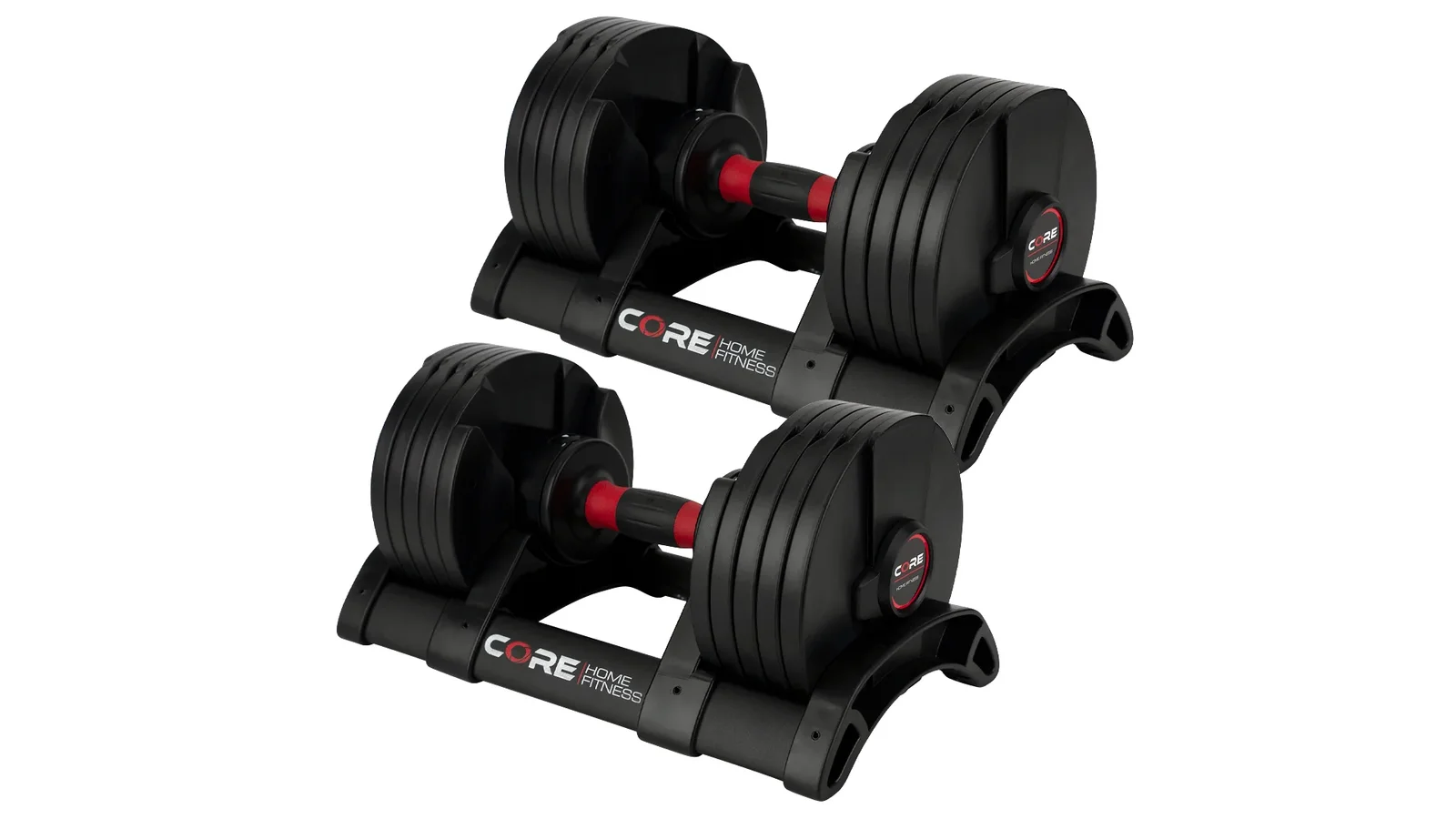
- Expanded setup: Adjustable dumbbells (like the Xtreme Dumbbell Set) give you the full weight range in one unit, which removes the need to buy multiple fixed-weight dumbbells as you get stronger.
- Advanced setup: A power rack like the Apex Rack opens up barbell training — squats, deadlifts, bench press, and rows — which provides the highest ceiling for long-term strength development.
How to Stay Consistent
Consistency is the variable that separates people who make progress from people who don't. A few evidence-backed strategies for beginners:
- Schedule your sessions like appointments — put them in your calendar and treat them as non-negotiable.
- Start shorter than you think you need to — a 25-minute session you'll actually do is better than a 60-minute session you'll skip.
- Track your workouts — write down what you lifted. Seeing your numbers go up is powerfully motivating.
- Accept imperfection — missing a session is not a failure. What matters is your average effort over weeks and months, not any single day.
A Note on Form
Good form protects you from injury and ensures the right muscles are doing the work. As a beginner, use lighter weights than you think you need and focus on controlled, deliberate movements. If you feel pain (not discomfort — actual pain) in a joint or your lower back, stop and reassess the movement or reduce the weight. There is no training result worth a serious injury.
You're Ready
The barrier to starting strength training at home is genuinely low. You need a small amount of space, a couple of basic tools, a repeatable program, and the commitment to show up three times a week. Everything else — the advanced techniques, the additional equipment, the nutrition nuances — can come later. Start simple. Train consistently. Add weight over time. The results will follow.
Start Your Strength Journey
Browse our strength training equipment — from adjustable dumbbells and kettlebells for beginners to full power cages for advanced lifters.
Shop Strength Equipment